“Long before data, there is intuition. Alchemy preceded chemistry, and natural philosophy gave rise to physics.
History reminds us that many paradigms begin as art.”
— Jennalyn Ponraj, Artist, Founder, Futurist











Alongside NDA-protected engagements with Fortune 500 leaders across AI, tech, and entertainment.
READ THE WHITE PAPER
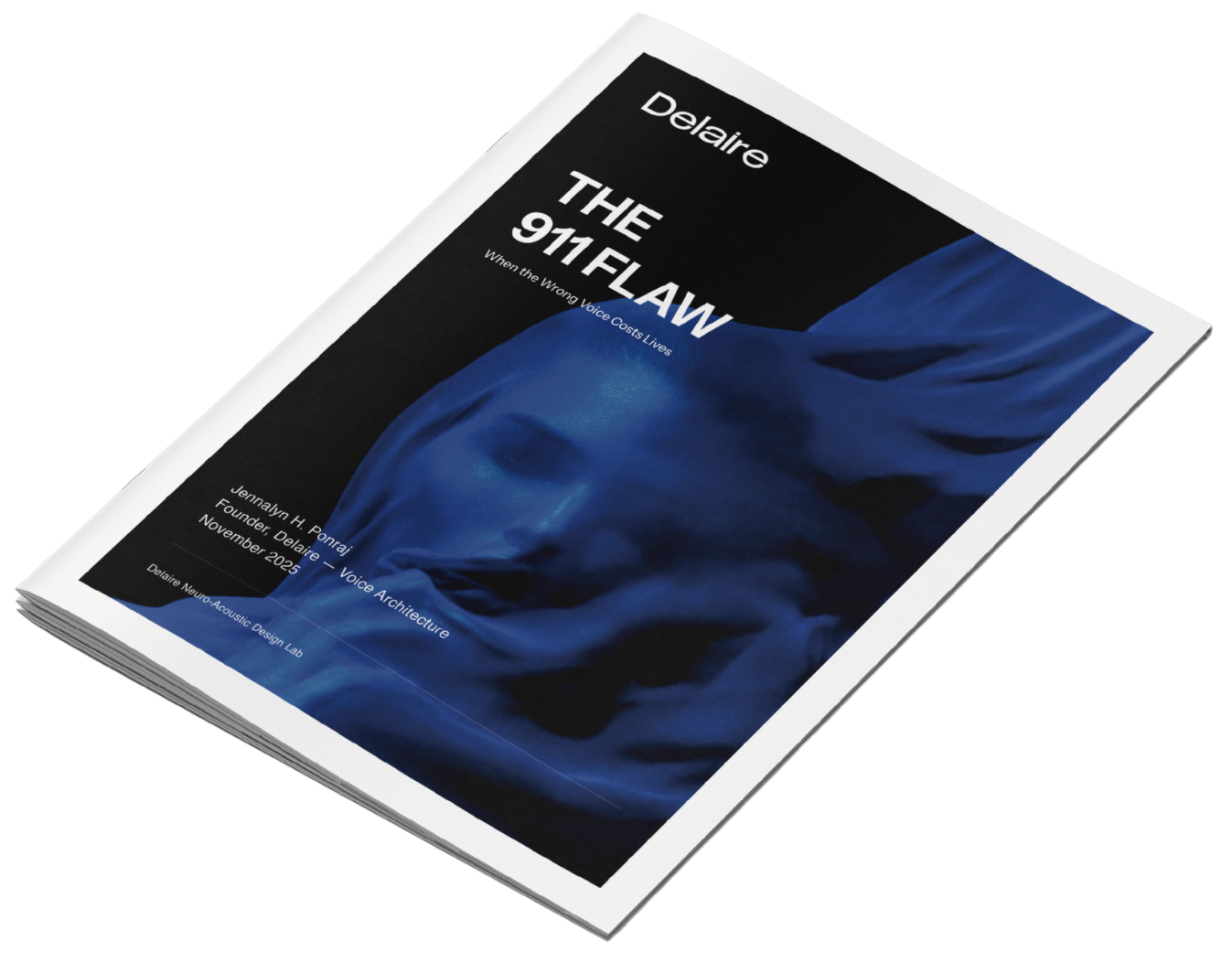
Jennalyn’s breakthrough white paper, “The 9-1-1 Flaw,” reveals how automation designed for efficiency—rather than biology—will reshape crisis response. It outlines the first proposed biometric standard for measuring trust in synthetic voice.
Signature Talks
Based in Los Angeles. Available worldwide.
The Future Has a Voice
Sonic Strategy in the Age of AI
How the next decade of global trust, brand power, and human–machine communication will be decided by sound
-
In the age of AI, your brand’s voice is more powerful than your logo. And the companies that master emotional prosody will dominate global trust, loyalty, and market share.
People don’t trust machines through screens anymore, they trust them through voices.
Modern AI has mastered language generation, accuracy, latency, and scale.
What it hasn’t been designed for, is the biological dimension that decides whether a user feels connected, calm, guided, or alienated.In this talk, Jennalyn Ponraj reveals why voice is now the most powerful, and most undervalued, asset in global business.
Drawing from two decades as a professional vocalist and the voice of global campaigns (Nike, Taco Bell, Kohl's, Victoria's Secret, AAA video games) and bridging neuro-acoustic research, she breaks down the exact sonic variables that influence human perception, memory, trust, and behavior.
Using real-world case studies from Alexa, Google Assistant, automotive voice systems, and crisis communication platforms, Ponraj demonstrates how prosody—not text, accuracy, or UX, determines whether an AI interface succeeds or fails emotionally.
And she introduces a new standard for enterprise teams:
If your AI has a voice, you must engineer it, not guess it.
-
The new science of sonic trust
How to evaluate voices using biological and acoustic metrics
A practical framework to architect emotionally credible AI voices
Case studies they can apply immediately
A future-facing understanding of why voice is the most overlooked growth lever in business
A clear roadmap for designing AI voices that align, perform, and convert
This talk gives executives and engineers something they’ve never had before:
a rigorous, science-backed way to build voice experiences that actually work. -
Fortune 500 brand leaders
CMOs, CPOs, CTOs, CXOs
AI & ML teams
UX researchers
Automotive & healthcare innovators
Big Tech
Government & infrastructure organizations
Global conferences focused on AI, brand, design, trust, and human–machine interaction
Voice Architecture
Designing the Human Nervous System Into AI
From Prenatal Neuroscience to Synthetic Emotion
-
Voice is not just communication, it is biological infrastructure. And for the first time, we can design it.
The first environment humans inhabit is sound
The auditory system develops before birth, imprinting maternal prosody as the “template for safety.”
This creates lifelong neural pathways for emotional regulation.Voice as a biological regulator
How tone, rhythm, frequency, and contour shift a human from stress to calm in seconds — and how synthetic prosody interacts with these systems.The question no one is studying: can artificial voices imprint?
As infants consume synthetic voices at unprecedented frequency, we must ask whether artificial prosody can shape early neural development.Voice as prosthetic regulation
How designed voices could support:NICU infants
mothers with vocal impairments
trauma and anxiety recovery
high-performance environments (surgeons, soldiers, athletes)
Beyond compensation: voice as human enhancement
If the nervous system can be shifted on command through voice, what does that mean for performance, learning, and stress regulation?Why Voice Architecture™ is a global imperative
As governments, automakers, hospitals, banks, and customer-service ecosystems adopt synthetic voice at scale, the world needs a new standard: biometric validation before deployment.Not for safety alone, but for performance, loyalty, identity, and trust.
-
• The future of voice-mediated human enhancement
• What sounds to make the next time you’re stressed — and why they work
• How to design artificial prosody for maximum biological impact
• The unsettling history of psychoacoustic manipulation — and what it means for AI
• The ethical and biometric standards required for safe synthetic voice
• Practical recording guidance for getting the most accurate, high-fidelity clones -
Academic institutions, global policy makers, AI labs, healthcare systems, neuroscientists, voice-AI companies, early childhood organizations, ethics boards, and anyone designing the future of human-machine interaction.